
Injection Moulding is a high-pressure, high-temperature manufacturing process predominantly used for the mass production of identical thermoplastic or thermoset polymer parts with complex geometries and tight dimensional tolerances. It is characterized by its cyclical operation, where material is plasticized, injected into a closed mould, cooled, and ejected as a solid part.
1. Fundamental Process Cycle
The cycle is a sequential, automated process typically lasting between 10 to 60 seconds, comprising four primary stages:
-
Stage 1: Clamping
The two halves of the mould (the stationary “cavity side” and the moving “core side”) are securely closed and held together by a hydraulic or electric toggle clamping unit. Clamping force, measured in tons (e.g., 50 to 6000+ tons), must exceed the internal injection pressure to prevent “flash” (material leaking at the mould parting line). -
Stage 2: Injection
Plastic resin in pellet form is fed from a hopper into a heated barrel containing a reciprocating screw. The screw rotates (plasticizing), conveying, compressing, and shear-heating the pellets into a homogeneous molten state. The screw then acts as a ram, moving forward to inject a precise volume (the “shot”) of this melt into the closed mould cavity through a sprue and runner system. Injection occurs under high pressure (typically 500 to 2,000+ bar) to ensure complete cavity filling before the material solidifies. -
Stage 3: Cooling & Solidification
Once the cavity is packed, the molten plastic begins to cool and solidify in contact with the temperature-controlled mould walls. The material shrinks as it cools, so additional melt may be forced into the cavity (“holding pressure” or “packing phase”) to compensate and prevent sink marks and voids. Cooling time constitutes the majority of the total cycle time and is critical for dimensional stability and warpage control. -
Stage 4: Ejection
After sufficient cooling, the clamping unit opens the mould. Ejector pins, plates, or sleeves, integrated into the moving half, advance to mechanically push the solidified part(s) and the solidified sprue/runner system (the “cold runner”) from the mould. The mould then closes, and the cycle repeats.
2. Critical Machine Components
-
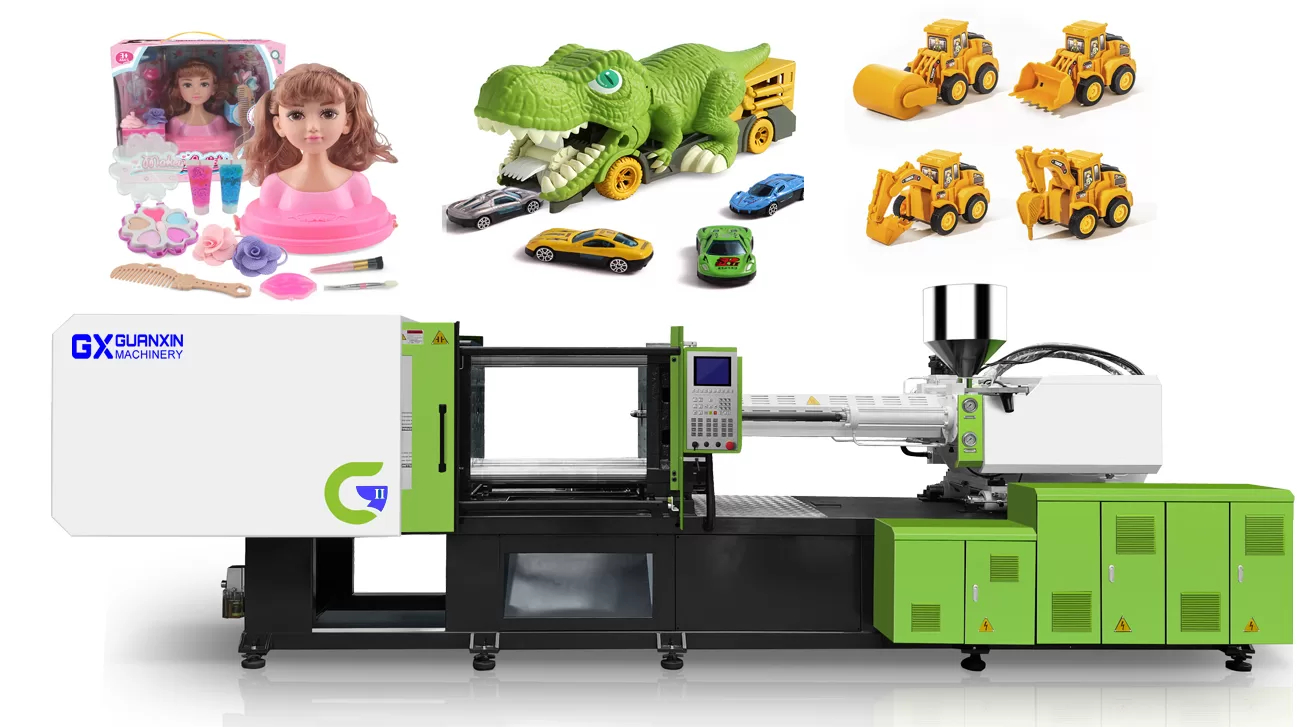
Injection Unit: The plastification system. Comprises the hopper, barrel, heater bands, and the central reciprocating screw. The screw design (compression ratio, L/D ratio, flights) is material-specific.
-
Clamping Unit: The mould holding system. Provides the force to keep the mould closed against injection pressure. Types include toggle (mechanical leverage) and hydraulic (direct piston) systems.
-
Mould (Tool or Die): A custom-fabricated, hardened steel (or aluminum for prototypes) block containing the part’s negative impression. It is an engineered system itself, incorporating:
-
Cavity & Core: Form the part geometry.
-
Runner System: Channels (cold or hot) guiding melt to cavities.
-
Gates: Small orifices where melt enters the cavity; critical for flow control and part finish.
-
Cooling Channels: Circulate water/fluid to control mould temperature.
-
Ejection System: Pins, sleeves, stripper plates.
-
Vents: Minute channels to allow trapped air to escape.
-
Draft Angles: Taper on vertical walls to facilitate ejection.
-
3. Material Science & Classification
-
Thermoplastics (≈80% of use): Can be repeatedly melted and solidified (e.g., Polypropylene (PP), Acrylonitrile Butadiene Styrene (ABS), Polyethylene (PE), Polycarbonate (PC), Nylon (PA)). Ideal for recycling sprues/runners.
-
Thermosets: Undergo an irreversible chemical cure (cross-linking) when heated (e.g., epoxy, phenolic). Requires a heated mould.
-
Elastomers: Rubber-like materials that can be injection moulded (TPEs, silicone).
-
Additives: Materials are compounded with colorants, UV stabilizers, flame retardants, glass/carbon fibers (for structural reinforcement), plasticizers, and more to achieve specific properties.
4. Advanced Process Variations
-
Two-Shot / Overmoulding: Moulding a second material over a first substrate (e.g., soft-grip handles).
-
Insert Moulding: Moulding plastic around a pre-placed metal or electronic insert.
-
Gas-Assisted Injection Moulding (GAIM): Injects nitrogen gas to create hollow sections, reducing weight and sink marks.
-
Micro-Injection Moulding: For ultra-precise, sub-gram parts (medical components).
-
Liquid Silicone Rubber (LSR) Moulding: For high-purity, heat-resistant silicone parts.
-
Metal Injection Moulding (MIM) & Ceramic Injection Moulding (CIM): Uses fine metal/ceramic powders mixed with a polymer binder, which is later removed and sintered.
5. Design for Manufacturing (DFM) Principles
Successful injection moulded part design requires adherence to key DFM rules:
-
Uniform Wall Thickness: Promotes even flow and cooling, minimizing warpage and sinks.
-
Draft Angles: Minimum 1°-2° per side on cores/cavities for ejection.
-
Ribs & Gussets: Used to add stiffness without increasing wall thickness.
-
Fillets & Radii: Rounded corners reduce stress concentration and improve flow.
-
Gate Location: Determines weld line positions, fiber orientation, and cosmetic appearance.
-
Undercuts: Features that prevent straight ejection; require complex (and costly) side-actions, lifters, or collapsible cores in the mould.
6. Advantages vs. Disadvantages
| Advantages | Disadvantages |
|---|---|
| Extremely high production rates & repeatability | Exceptionally high initial tooling cost & lead time (weeks/months) |
| Low per-part cost at high volumes | Economically unviable for very low volumes (typically < 1,000-10,000 parts) |
| Minimal finishing or secondary operations required | Significant design constraints imposed by process physics |
| Ability to produce highly complex, intricate geometries in a single step | Mould modifications are difficult and expensive |
| Excellent surface finish & part detail achievable | Process optimization (cycle time, quality) is complex and iterative |
| Wide range of compatible materials & colors | Scrap generation (sprue, runners, defective parts) though often reground |
7. Pervasive Applications
The process is ubiquitous across nearly every industry:
-
Automotive: Bumpers, dashboards, light housings, ductwork, connectors.
-
Consumer Electronics: Housings for phones/laptops, buttons, connectors.
-
Medical: Syringes, IV components, surgical tool housings, diagnostic devices.
-
Packaging: Thin-wall containers, bottle caps, closures.
-
Consumer Goods: Toys, kitchenware, household appliance housings, power tools.
8. Modern Trends & Industry 4.0
-
All-Electric Machines: Superior precision, speed, and energy efficiency over traditional hydraulic presses.
-
Smart Moulding & IoT: Sensors monitor pressure, temperature, and viscosity in real-time for predictive quality control and process optimization.
-
Advanced Simulation Software: Moldflow analysis predicts fill patterns, cooling, warp, and structural performance before cutting steel, reducing development risk.
-
Sustainable Practices: Increased use of bio-polymers, post-consumer recycled (PCR) content, and energy recovery systems.
In essence, injection moulding is the cornerstone of modern polymer mass production—a sophisticated interplay of mechanical engineering, material science, thermodynamics, and precision toolmaking that transforms raw pellets into the vast array of plastic products that define contemporary life.